 HONG KONG TRAILS & TOURS
Key facts: Hong Kong street art
-
Hong Kong has no designated “free walls” for public graffiti.
-
Commissioned murals can stay for years; uncommissioned pieces often disappear quickly.
-
HKwalls has been running an annual street art festival since 2014, with the 2026 edition from March 21 to 29.
-
The King of Kowloon’s calligraphy can still be seen at Tsim Sha Tsui Ferry Pier.
-
International artists like Aches (Ireland), Jaune (Belgium), and Herakut (Germany) have major works across the city
Hong Kong Street Art Tour: What to Expect
In Hong Kong, there is always more than meets the eye. The city is globally known as a high-speed finance hub, but it’s also one of the best places in the world to go hiking. The city is full of wonderful surprises, whether that is backyard hikes, street art made by artists around the world or the not-so-wonderful surprise, humidity.
The aim of this blog is to introduce you to Hong Kong street art culture and give you a starting point to where to find the city’s best murals and graffiti spots, from the famous Graham Street selfie wall to tiny stencils in Central and the lion dance mural in Kennedy Town.
For context, Hong Kong’s walls split into two worlds: commissioned murals that stay for years and uncommissioned pieces that can vanish overnight when the municipal cleaning crews roll through. This guide helps you find both, plan an efficient route by the Metro (referred to as “MTR” locally), and understand the artists behind the work.
If you want a deeper cultural understanding of HK by way of some really interesting stories, my heritage and cultural walking tours in Central, Sheung Wan and Sai Ying Pun can also include curated street art stops.
Beyond the Selfie Spots and “Hidden” Art
If you rely on social media and AI algorithms to find street art in Hong Kong, you will inevitably be pointed to the corner of Hollywood Road and Graham Street. There, crowds of tourists line up on a narrow pavement to take the exact same photo in front of Alex Croft’s iconic, blue-hued mural of traditional tong lau tenement houses.
It is a stunning, highly photogenic piece of art. But treating it as the definitive Hong Kong street art experience is like eating a single dim sum dumpling and claiming you have mastered Cantonese cuisine. To truly experience the city’s concrete canvas, you have to look beyond what your phone tells you to do. There is art all around; you just have to look up!
Key Hong Kong Street Art Artists and Where to Find Them
Hong Kong’s walls are a mixing point of global cultures, featuring local legends alongside French, Finnish, German, Belgian and Irish artists. Below are some of the key names to look for as you build your own Hong Kong street art tour.
The Original Street Artist: King of Kowloon
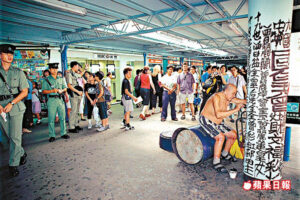
Long before Hong Kong’s mural festivals and Instagram walls, one man defined the city’s street art: Tsang Tsou Choi, known as the King of Kowloon. For decades, he covered electrical boxes, overpasses and concrete pillars across Kowloon with dense, black ink calligraphy, declaring his ancestral land rights and railing against British colonial rule with slogans like “Down with the Queen of England.”
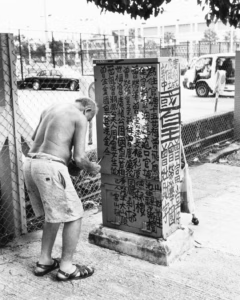
His uncommissioned scribbles turned the entire peninsula into his personal canvas. To some, he was a troublemaker; to others, a folk hero keeping traditional calligraphy alive in public space. Today, his work is shown in galleries and museums, including M+, but his most authentic pieces were always meant for the streets.
You can still spot remnants of his calligraphy at Tsim Sha Tsui Ferry Pier and in a few other public locations, small, fading traces of the man who first treated Hong Kong as an open-air gallery.
(For a deeper dive into his fascinating history and transformation from a local eccentric to a cultural icon, I highly recommend reading The Guardian’s excellent long-read article: “The King of Kowloon: my search for the cult graffiti prophet of Hong Kong.“)
Encountering the King of Kowloon, M+ Talks
Global Names on HK Walls: Aches, Jaune, Herakut and More
HKwalls was founded in 2014 by passionate art advocates Jason Dembski, Stan Wu, and Maria Wong. For the past 12 years, this nonprofit organisation has been creating safe, legal spaces for local and international artists to showcase their talents without having to dodge the police. By securing advance approvals from municipal bodies and property owners, they have transformed public perception from viewing street art purely as vandalism to valuing it as a world-class cultural asset. Some of the artists mentioned below were also attracted by the annual event they host every year in March:
Aches’ 3D Lion Dance (Ireland):
Head to Cadogan Street in Kennedy Town to find a stunning mural by Dublin artist Aches. Using subtractive colour theory, layering cyan, magenta, and yellow, he painted a dizzying, gorgeous celebration of Hong Kong’s lion dance culture that practically pops off the wall.
Jaune’s Harbingers of Chaos:
Down in Central, Belgian stencil artist and urban interventionist Jaune creates tiny, hilarious stencils of municipal sanitation workers. Born from his own experience working in the profession, his art highlights a paradox: despite wearing garish fluorescent clothing, these workers exist in the background, becoming almost invisible to the average person. Since 2011, Jaune has “freed” these characters, symbolically placing them in absurd scenarios where those meant to keep the world tidy become harbingers of chaos. While his roots are in unauthorised urban exploration inspired by the Kowloon Walled City, many of his surviving miniatures in Hong Kong are now legally commissioned by local bars and restaurants.
Elsa Jean de Dieu:
Providing a bright contrast to the city’s intensity, this French artist’s popular, legally commissioned works, such as the laughing portrait surrounded by soap bubbles on Peel Street in SoHo, aim to provide a cheerful visual break and a positive emotional impact for busy city residents.
Herakut:
This famous German street art duo, composed of artists Hera (Jasmin Siddiqui) and Akut (Falk Lehmann), has left a massive mark on the city. Their extensive, commissioned work in Hong Kong is closely tied to the HKwalls street art festival, bringing their distinct, emotive style to massive, legal urban facades.
Invader’s Pixel Mosaics:
The infamous anonymous French street artist known as “Invader” has repeatedly “invaded” Hong Kong, cementing his ceramic tile Space Invaders high up on buildings and street corners. While the city’s grey warriors notoriously chipped away many of his early unauthorised pieces, a dedicated subculture has emerged to document and protect what survives. If you want to go down a digital rabbit hole before hitting the streets, you can track the real-time status of his surviving pixelated mosaics through the Invaders Finder database.
Riitta Kuisma:
Bridging the gap between the underground and the official, this Finnish artist’s work is strictly commissioned. She has been painting public mural projects in Hong Kong since 2015, frequently hired by everyone from the Home Affairs Department and District Councils to local charities, hotels, and restaurants.
Go Hung’s Recycled Litter:
In Sheung Wan, local artist Go Hung takes a completely unauthorised approach. He collects discarded cardboard from the streets and sculpts it into satirical pieces mocking the wasteful consumerist culture he resides in. Instead of seeking commissions or selling them in galleries, he deliberately “litters” his finished pieces back onto the sidewalks for unsuspecting passersby to discover.
Local voices: Go Hung and Hong Kong’s DIY Scene
How to Actually Do a Hong Kong Street Art Tour (Step by Step)
Pick your route (2 to 3 hours is ideal).
Central and Sheung Wan (best first-timer loop)
-
Focus: Famous mural, hidden stencils, mixed commissioned and uncommissioned vibes.
-
Time: 2 to 3 hours walking.
-
MTR: Start at Central MTR (Exits D2 and E), end at Sheung Wan MTR (Exit A2 or B).
Central and Kennedy Town (photo-heavy, fewer alleys)
-
Focus: Graham Street mural plus Aches’ lion dance, with a few Central stencils.
-
Time: 2.5 to 3.5 hours, including MTR.
-
MTR: Central to Kennedy Town (MTR Island Line).
Advanced: Kwun Tong Pillars Add-On
-
Focus: Massive outdoor history murals on 30 pillars.
-
Time: plus 1 to 2 hours.
-
Access: Kwun Tong MTR, then a short taxi or bus to Hoi Bun Road.
Quick Reference: Best Hong Kong Street Art Areas at a Glance
| District | Best for | Key spots to look for | MTR access |
| Central & SoHo | First-time visitors; mix of famous murals and hidden stencils | Graham Street & Hollywood Road mural (Alex Croft), Wyndham/Peel Street stencils (including Jaune’s tiny workers), Peel Street portrait by Elsa Jean de Dieu | Central (Exits D2, E, F) |
| Sheung Wan | Hidden alleys, local artists, “graffiti lane” vibe | “Graffiti Lane” (Sai Street) with blocky characters and Fever’s neon work, Mooncasket mural at Craftissimo, Tank Lane walls | Sheung Wan (Exits A2, B) |
| Kennedy Town | Big, photogenic murals; fewer crowds | Aches’ 3D lion dance mural (21 Cadogan Street, outside The Merton) | Kennedy Town (Exit B, then 5–7 min walk) |
| Kwun Tong | Massive outdoor history murals; advanced explorers | “Lift Up Kowloon East” project – 30 pillars depicting local history from Song dynasty to today (Hoi Bun Road area) | Kwun Tong + short taxi or bus ride |
| Sai Ying Pun & Wong Chuk Hang | Community-focused redevelopment art, industrial-scale facades | Ki Ling Lane “Art Lane”, Chung Ching Street murals, South Island warehouse walls | Sai Ying Wan (Exits B1/B2) / Wong Chuk Hang (Exits A/B) |
How to use this:
-
For a compact 2- to 3-hour tour, combine Central and SoHo with Sheung Wan.
-
For a photo-heavy half day, add Kennedy Town to the Central and Sheung Wan loop.
-
For an advanced session away from the crowds, plan a separate trip to Kwun Tong or Wong Chuk Hang.
-
Prefer a guided experience? I run heritage and cultural walking tours in Central, Sheung Wan and Sai Ying Pun that include curated street art stops plus hidden history and laneways.
Here are also some other special projects worth knowing:
-
HKwalls ROOMS, a pop-up exhibition platform for independent galleries and artists.
-
Art on the Move: painted trucks converted into mobile galleries you can step inside.
-
EU Street Art Meets Hong Kong, pairing local art students with European artists in neighbourhoods like Sai Ying Pun.
Hong Kong Street Art Frequently Asked Questions
Is graffiti legal in Hong Kong?
No. Unapproved graffiti is treated as property damage under Hong Kong law and can lead to fines and other legal penalties. Legal Hong Kong street art usually comes from private property owners or curated projects like HKwalls, which get approvals in advance.
Who was the King of Kowloon?
Tsang Tsou Choi, known as the King of Kowloon, was a famous Hong Kong citizen who covered public walls and electrical boxes in dense, unauthorised ink writing for decades. He was famous for his anti-colonial messages like “Down with the Queen of England” and for bartering his art for barbecue pork and rice.
Can you watch artists painting live?
During festival week, yes. HKwalls programmes live mural painting, workshops, art trucks and guided mural walks across the nine days.
What is the HKwalls Festival?
HKwalls is a nonprofit street art organisation that has been running an annual street art festival for the past 12 years, officially founded in 2014. The upcoming edition runs from March 21 to 29, 2026, bringing local and international artists together to paint legal, commissioned murals across the city.
How long does a Hong Kong street art walk take?
Two to three hours covers Central, Sheung Wan and Sai Ying Pun at a relaxed pace with photo stops. Add an hour for coffee breaks and side lanes.